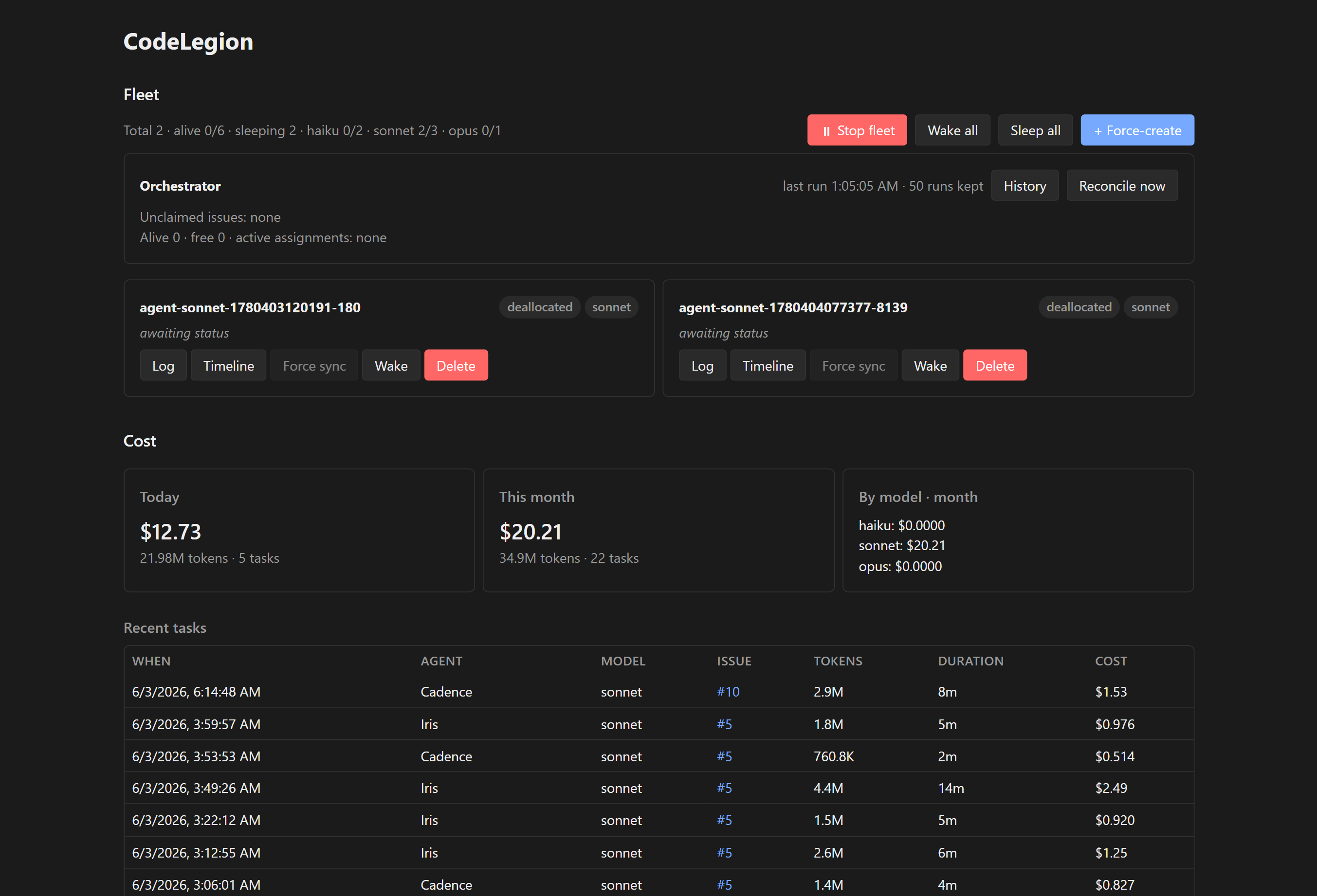
A fleet of autonomous Claude Code agents that picks up labeled GitHub issues, writes code and tests, and opens pull requests for human review. Self-hosted on Azure. Open source.
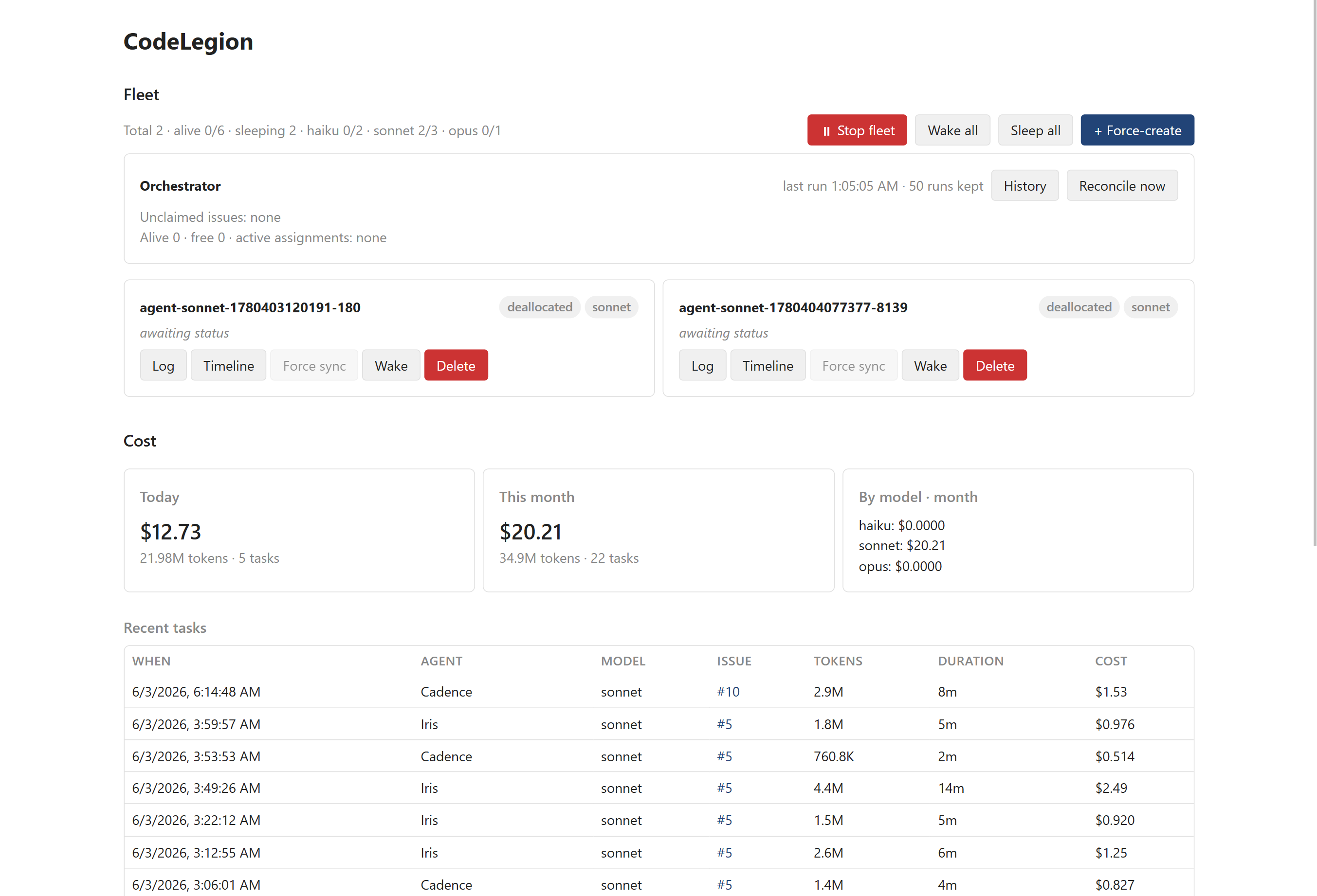
Fleet state and per-agent controls, live cost by day / month / model, and a full task history with the exact cost of every run — auto-refreshed, in dark or light to match this page.
What it does
An autonomous engineering team in your resource group
Turns the routine, well-scoped half of your backlog — bug fixes, dependency bumps, test additions, mechanical refactors — into reviewed pull requests. Without supervision.
Label-driven dispatch
Drop agent-ready on a GitHub issue. Within three minutes a fresh agent claims it and starts writing.
Model routing per issue
Tag model:haiku for trivial fixes, sonnet for standard work, opus for hard problems.
Wake on demand
VMs spin only when work exists; self-deallocate after 10 idle minutes. You pay for what you use.
Agents with personality
On first boot each agent picks its own name, emoji, and personality — and writes every comment and PR in that voice. Same rigor, distinct character.
Cost transparency, per task
Every completed task posts a cost summary on the issue: $0.82 — sonnet · 96K tokens · 9m 40s.
Triage proposals for vague work
Under-specified issues get a structured proposal and wait for approval. The agent never silently guesses.
One-click Stop / Start fleet
Halt every running agent and deallocate. Persists across controller restarts.
Self-hosted. No SaaS lock-in
One Azure Web App in your subscription. GitHub App auth. Secrets never leave your tenant.
Live dashboard
Per-VM state, reconcile history, cost breakdown, full audit trail. Auto-refresh is surgical.
Personality
Every agent is a character
On first boot, each agent names itself, picks an emoji, and adopts a personality — and it carries through every comment and pull request it writes. Same engineering rigor, distinct voice. These are illustrative; your fleet generates its own.
🦉
Athena
Meticulous · formal
“Acceptance criterion 3 was ambiguous, so I scoped it narrowly and noted the remainder for review. Tests cover both verified paths.”
🦊
Rusty
Pragmatic · dry wit
“Two-line fix, twelve-line test. This bug was older than the file's last commit. Anyway — all green. 🦊”
⚡
Volt
Fast · upbeat
“Dependency bump done and patched the breaking change in the config loader. Checks passing across the board — ready to ship! ⚡”
Get running
Three steps. ~15 minutes.
CodeLegion provisions its own infrastructure. Give it three things and walk away.
No new tools to learn. No SaaS. No data leaving your tenant. Every action reviewable by a human before it merges.
Reviewed before merge.Every change opens a PR. Branch protection enforces 1 review + CODEOWNERS.
Tests per acceptance criterion.Every PR body maps each acceptance criterion to its covering test.
Pay per task, not per seat.Anthropic tokens + Azure infra. Typical issue lands between $0.30 and $3.
Secrets stay in your tenant.GitHub App PEM, Anthropic key, webhook secret — all in your Web App's App Settings.
Audit trail is GitHub itself.Decisions, plans, test results, cost — every step lives in issue comments and PR diffs.
MIT licensed. Yours to fork.Open source, single-instance by design, ~5K LOC controller.
How it works
The lifecycle of an issue
A single flow, end-to-end. The dashboard makes every state visible — and every cost.
Label issue
agent-ready + model:*
→
Reconcile
spin or wake VM
→
Agent works
claim → plan → code → test
→
Pull request
tests per criterion
→
Human reviews
approve, merge, done
Community
Built in public. Numbers, live.
Pulled from GitHub on page load. Refreshes whenever you do.
—
Stars
—
Forks
—
Contributors
—
Releases
Reviews
What AI evaluators say
Honest first-look reviews from third-party AI models, prompted with the project's README, SETUP, and architecture spec.
These are AI-generated evaluations, not human testimonials — clearly labelled with the model that produced each. Real-user testimonials replace these as they come in.
Ship from your backlog, not your inbox.
Stand up a fleet on Azure in fifteen minutes. Label an issue, walk away, review the PR.